
What Is Malaria?
Malaria is one of the most common infectious diseases in the world, especially in the Southern hemisphere where 90% of the deaths occur in sub saharian Africa, that can be fatal. The disease is caused by protozoan parasites of the Plasmodium genus. There are over 120 species of the Plasmodium however there are ony four types that can infect humans: these are Plasmodium falciparum, Plasmodium vivax, Plasmodium ovale and Plasmodium malariae. The first one is the most serious form of the parasite and is considered malignant as it can end in fatality however the last three are less serious and are so termed benign.
It is the Plasmodium falciparum that is responsible for most of malaria deaths and has the quickest onset of symptoms, usually being seen within a few months. The other three forms can take up to years for the symptoms of the disease to first appear.
Malaria is spread by the bite of a female mosquito and that only, it can therefore not be spread by human to human contact. Even though it is only spread through the bite of a mosquito more than 2 million people die each year from the disease, most of these people are mainly children.
The disease is associated with poverty, as normally the areas where the disease effects has a low economy and so the funds are not available to treat and prevent the disease from spreading. It is thought to cost the African government US$12 billion a year however from seeing how many people this disease affects it is clear to see that much more is needed to prevent the disease causing so many deaths.
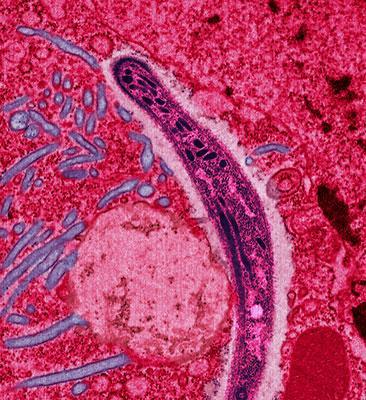

A Plasmodium sporozoite traverses the cytoplasm of a mosquito midgut epithelial cell in this false-color electron micrograph.
Image courtesy of Wikipedia. This image is in the public domain and thus free of any copyright restrictions.